 By
By
Buying your teen an e-bike? Slow the decision down.
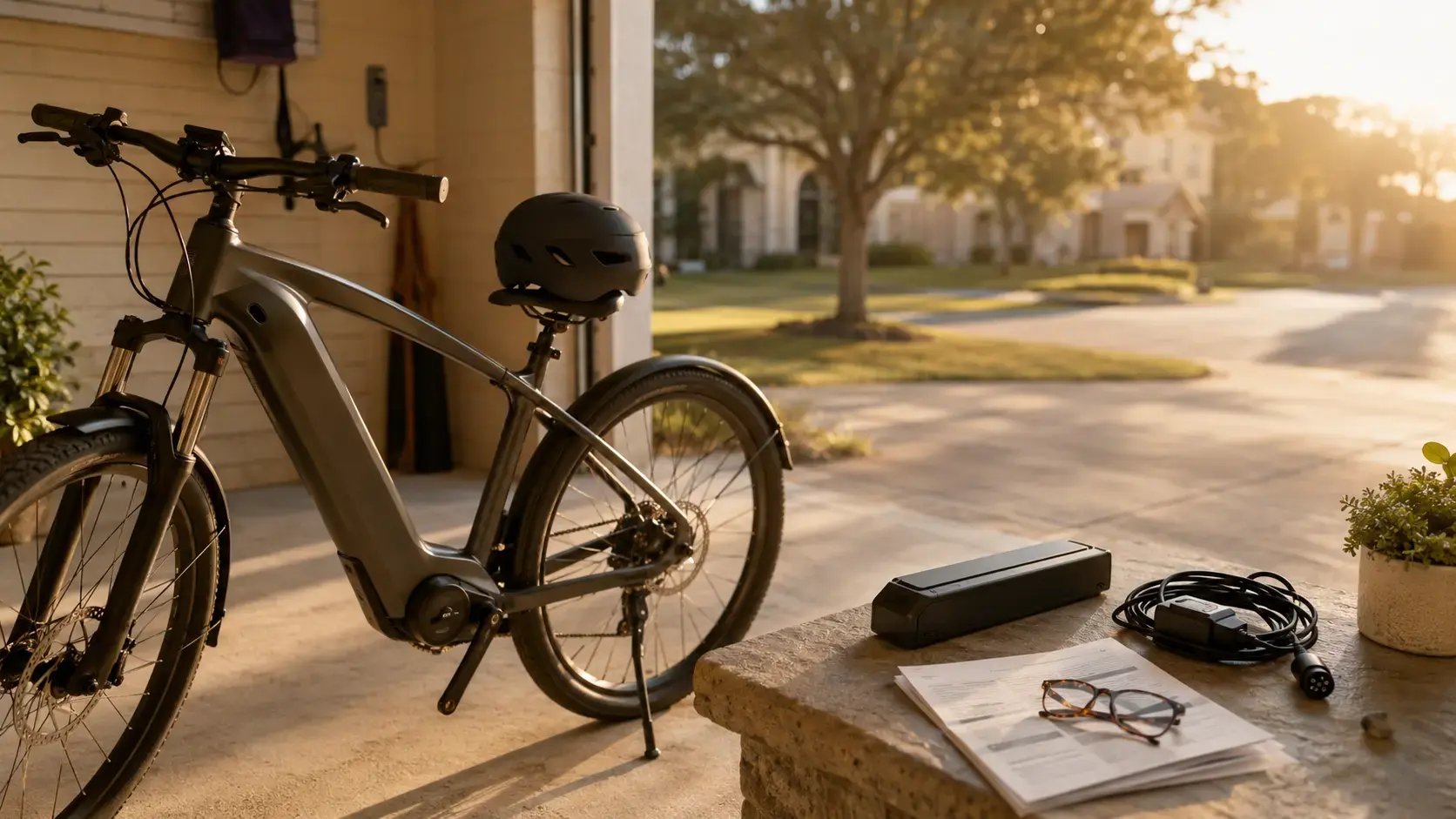
An e-bike can feel like freedom before the keys. For a parent, it is also a speed, battery, liability, and policy-language decision.
The parent's brief
If you are buying your teen an e-bike in Texas, start with three questions. What class is it, how safe is the battery system, and how will your insurance respond if your child hurts someone. The bike is not just a gift. It is a risk decision sitting in the garage, charging near the house, and riding through neighborhoods where families, cars, pets, and pedestrians all share the same space.
Before my grandfather ever trusted me behind the wheel of that red 2002 Ford Excursion, freedom started smaller. A bike. A route. A little space to prove you could handle more. That is what parents are really buying with an e-bike. Not just transportation. They are buying responsibility, and responsibility deserves a contract read before something goes wrong.
Charles McDade, LUTCF
Do not start with the price. Start with the class.
Texas separates e-bikes into Class 1, Class 2, and Class 3. That label matters because speed and motor behavior change the risk. A properly classified electric bicycle has fully operable pedals, a motor under 750 watts, and assisted speed that tops out at 28 miles per hour or less.
Pedal assist to 20 miles per hour
The motor helps only while the rider pedals. For many families, this is the cleanest first conversation because the bike still behaves most like a bicycle.
Throttle assist to 20 miles per hour
The throttle can move the bike without pedaling. That may be convenient, but it can also surprise a younger rider in a driveway, sidewalk, or parking lot.
Pedal assist up to 28 miles per hour
Texas law says a Class 3 rider must be at least 15 years old. That speed feels different around traffic, intersections, and neighborhood streets.
Class, speed, and wattage should be visible
Texas law requires the seller or manufacturer to label the class, top assisted speed, and motor wattage. If the label is missing or the bike has been modified, slow down.
The painful part is not the bike. It is the assumption.
Parents often assume the home policy, renters policy, auto policy, or umbrella policy will naturally follow the child. Sometimes part of that is true. Sometimes the policy language turns the e-bike into a motorized-vehicle problem.
TDI warns that home policies can have limited coverage for small motorized vehicles, especially away from the property or on streets. TDI also warns that auto policies probably will not cover an electric scooter accident. E-bikes are not identical to scooters, but the insurance lesson is the same. Read the contract before the child rides.
- Liability. Ask how the policy responds if your teen hits a pedestrian, another cyclist, a parked car, or another child. Start with personal liability, then check umbrella language.
- The bike itself. Ask whether theft, fire, collision, or off-premises damage is covered. Some expensive bikes may need a scheduled item conversation, similar to scheduled personal property.
- The deductible. If damage is covered, the loss may still fall below the deductible. Do not create a claim problem over a small physical damage loss.
- The umbrella. Do not assume umbrella coverage solves everything. The umbrella follows exclusions too, and the underlying policy has to be read first.
The charger belongs in the insurance conversation too.
Modern e-bikes are heavier, faster, and harder to control than traditional bikes. Chubb also notes that lithium batteries bring fire risk. UL 2849 looks at the e-bike electrical system, including the drive train, battery system, and charger combination. That is why the battery conversation should happen before the box is opened in the garage.
Look for third-party certification
Ask for proof that the full e-bike electrical system is certified by a nationally recognized testing laboratory. Keep that documentation with the receipt.
Use the charger that came with the bike
Do not mix chargers. Plug directly into a wall outlet. Avoid extension cords, power strips, overnight charging, or charging near an exit path.
Keep the battery dry and away from heat
A hot garage, damaged battery, or wet charging area can turn a transportation purchase into a home-risk problem.
Do not tune it past the label
If a bike is modified to change speed or motor engagement, Texas law requires the label to be updated. Your insurer may care too.
The road rules are local. The parent standard is higher.
Houston has a bicycle helmet ordinance for minors, and the parent can be part of the enforcement issue when a younger child rides without a helmet. The legal detail matters, but the McDade answer is simpler than the ordinance. Helmet every ride, every time.
The same goes for sidewalks, business districts, night riding, phone use, and group rides. A teen may be legally old enough to ride something. That does not mean they have enough judgment yet for every road, every speed, every group, and every shortcut.
That is not a no. It is the why behind the yes. We want the child to earn freedom without the family accidentally absorbing a claim, a lawsuit, a fire, or a coverage denial they never saw coming.
Sources worth opening before you buy.
Texas electric bicycle definitions for Class 1, Class 2, Class 3, wattage, pedals, and top assisted speed.
Texas operation rule that a Class 3 e-bike operator must be at least 15 years old.
Texas e-bike label requirements for class, top assisted speed, and motor wattage.
TDI guidance on motorized mobility insurance gaps and the need to check home and auto policy language.
TDI guidance on limited homeowners coverage for small vehicles when they leave the property or drive on streets.
UL explanation of fire safety certification for the e-bike drive train, battery system, and charger combination.
Practical safety guidance on helmets, visibility, braking, traffic rules, and battery charging discipline.
Houston helmet ordinance language for minors and parent responsibility for younger riders.
E-bike questions parents should ask before the ride.
How old does my child have to be to ride an e-bike in Texas?+
Texas has no statewide minimum age for Class 1 or Class 2 e-bikes. A Class 3 e-bike is different. Texas law says the rider must be at least 15 years old to operate one. A properly classified e-bike must have fully operable pedals, a motor under 750 watts, and a top assisted speed of 28 miles per hour or less.
What is the safest e-bike class for a teenager?+
For most younger or first-time teen riders, Class 1 is the safer starting point because the motor assists only while pedaling and stops assisting at 20 miles per hour. Class 2 adds throttle assistance up to 20 miles per hour. Class 3 can assist up to 28 miles per hour, which is a different level of speed around Houston traffic.
Does Texas require insurance for an e-bike?+
Texas does not require insurance for a properly classified e-bike, but that does not mean the e-bike is automatically covered by your home, renters, auto, or umbrella policy. The coverage question depends on the policy language, the bike class, how it is used, and whether an endorsement or separate policy is available.
Will homeowners insurance cover an e-bike accident?+
Sometimes, but parents should not assume it. Texas Department of Insurance guidance on small motorized vehicles and electric scooters warns that home policies often have limited coverage or no coverage for motorized-vehicle use, especially away from the property or on streets. Ask a broker to read the policy before the bike is ridden.
Will auto insurance cover an e-bike accident?+
Usually not under a standard personal auto policy, because an e-bike is not the insured auto listed on the policy. Texas Department of Insurance guidance on electric scooters also warns that auto policies probably will not cover that kind of electric mobility accident. The clean answer is to check the home, auto, and umbrella policies together.
What battery safety label should parents look for?+
Look for third-party safety certification for the full e-bike electrical system, not just a loose battery claim. UL 2849 is the main e-bike electrical system standard. It looks at the drive train, battery system, and charger combination. Use the manufacturer charger, avoid overnight charging, and do not block exits with a charging battery.
Does my teen need a helmet in Houston?+
Yes for minors in Houston. The City of Houston bicycle helmet ordinance defines a child as a person under 18, and parents can also be cited when a child under 14 rides without a helmet. Even where a rule is unclear outside Houston, the McDade answer is simple. Helmet every ride, every time.
Is an e-bike cheaper than adding a teen driver to auto insurance?+
It can be cheaper right now, and that is why many families consider it. The tradeoff is that it delays the driving and insurance conversation rather than making it disappear. If your teen will eventually drive, compare the e-bike risk, the coverage gap, and the future auto insurance plan before treating the e-bike as the whole answer.
Read the home, auto, and umbrella contracts together.
McDade compares the policy language, the e-bike class, the liability limit, the deductible, and the way the bike will actually be used. We translate the contract before claim time. No broker fees for personal lines. Local broker. National bench.
General insurance education only. Texas law, city ordinance, underwriting eligibility, carrier appetite, and the final policy contract govern. McDade Insurance is not a law firm.