
 By
By
I Got a Home Insurance Quote in the Mail That's Cheaper. Is It Real?
A price with your name on it is an estimate, built on guesses. Here is how to find out what the number leaves out before you decide anything.

The answer
Usually it is an estimate, not a quote. The number was built from public records or credit data, and it assumes discounts and coverage you may not have. Before you get excited, ask what you are really paying for. When the sender runs your real information and the coverage you have now, the price usually changes.
I still get the same mailers you do
I am an insurance broker, and the same letters land in my mailbox.
Mine came addressed to me at home. It showed an estimated premium of 3,000 dollars a year. It put my rebuild number at 531,503 dollars. It used a 2 percent deductible on every kind of loss, which on that limit is about 10,630 dollars out of my pocket before the policy pays a dime. It assumed five discounts, including a home and auto bundle and a home buyer discount, without ever asking me a question. The letter claimed many companies had raised rates by 35 percent or more and said it could save me 30 percent or more. Those are the sender's claims. The fine print said the number came from information they obtained and assumptions they made, and that the letter was not a contract or binder of insurance.
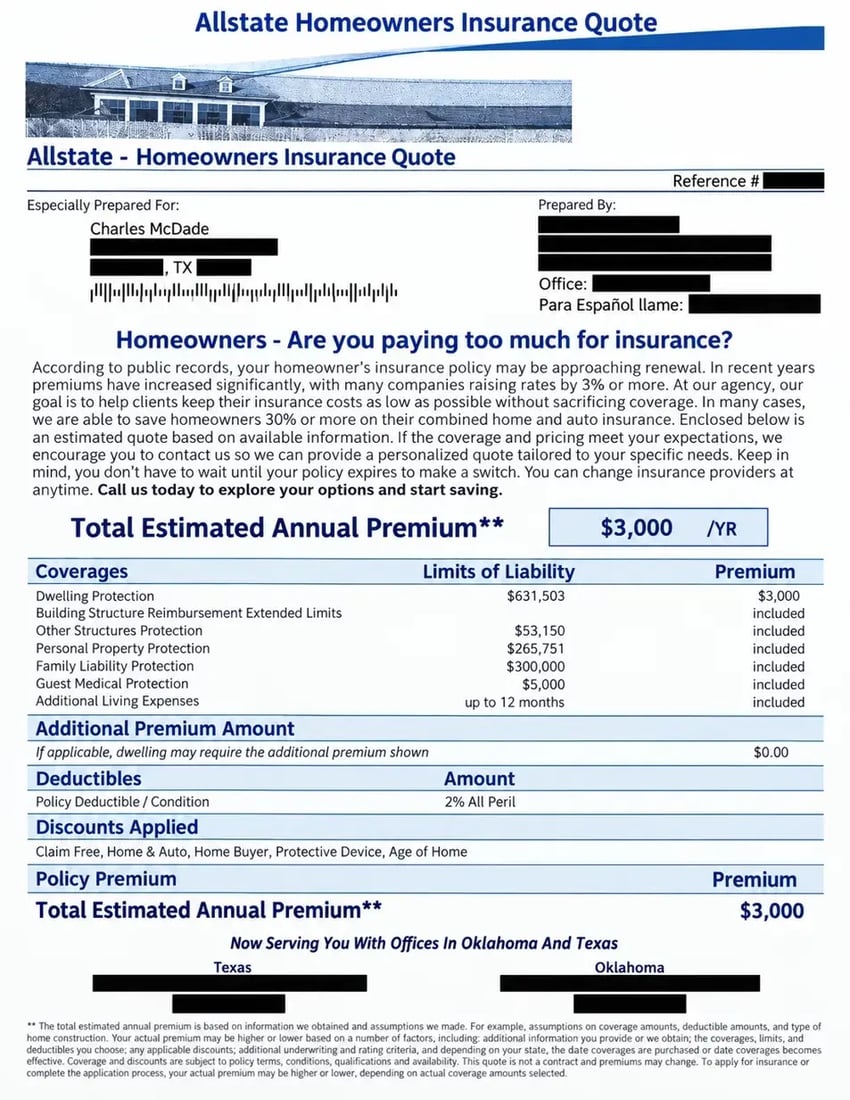
I laughed. Then I got a little sad. A price without the details behind it is a sales tool, and the details are what make a policy worth anything.
The first couple of times, I called the number. I am a student of my craft, and I wanted to see what would happen. One of two things happened every time. Either the price changed dramatically once they ran real information, or something was missing. No replacement cost on the roof. No water damage coverage. A deductible that did not match mine. Once we added back what I would expect in a policy, we were thousands of dollars away from the number on the page.
My grandfather used to say you lose relationships the same way you got them. If a relationship starts with a misrepresentation, the claim is not going to go any better.
How a number like that gets built
I spent years inside a large carrier, so I know how these letters are made. Running fresh numbers on every household is expensive. So the system runs older information, assumes the best possible insurance score, and layers on discounts you may not have. A new roof. A bundled auto policy. The number is designed to be low, because its only job is to make the phone ring.
Some of these letters are prescreened offers. The Federal Trade Commission explains that a company sets its requirements, then asks a credit bureau for a list of people whose credit reports meet them. Prescreening does not hurt your credit score. Other letters, like mine, say they were built from public records, such as a renewal date on file. Opting out of prescreened offers stops the first kind. The FTC says it will not stop offers built from other lists.
I understand the business reason. I still do not like what the letters do to people. They land when bills are higher than they have ever been and families are looking for relief. The letter sells the hope that something out there costs less and covers you the same way. In my experience, it rarely does.
The client who called the number
A client sent me one and asked whether he should jump. I joked that I would bet him the number would change the moment he called and asked for the coverage he already had. As a broker, I can also quote that same company's product written through independent agents, so I knew what the real number looked like. It was not close.
We called, just to double check and have some fun. Lets see if we can get near the price on the letter.... We weren't surprised, the company wanted a higher wind and hail deductible. It wanted a cap on water damage. It wanted to leave out wind-driven rain. It was no longer about the policy he had. It was about what they could give him at the lowest possible dollar.
There is a big difference between the lowest price you can find and the policy you are proud to have on your worst day.
Five questions to ask before you call
- What am I really paying for? Ask for the full list of what the policy covers and what it leaves out, in writing.
- Is this the coverage I have now? Put your declarations page next to the letter. Compare the dwelling limit, how the roof is paid, the water damage limit, and the wind and hail deductible in dollars.
- Which discounts did you assume? Each one you do not qualify for moves the price up.
- What changes once you run my real information? Ask for the number after the inspection, the claims history, and the current roof age are in.
- Who are you? Any agent selling in Texas holds a state license. Look the sender up before you share your information.
If the answers hold up, the letter may be a real option. If they do not, you learned that for the price of a phone call.
What I would tell my own family
Some people want a piece of paper. They have 200,000 dollars in the bank and only want coverage if the house burns. That is a real choice, and I respect it. Most of my clients, the doctors, the lawyers, the engineers, tell me the same thing. They want the policy they paid for to do what it is supposed to do. Paying 900 dollars less a year is no bargain when a burst pipe costs 60,000 dollars and the policy pays nothing.
I want every carrier to be profitable. Profitable carriers are stable and consistent, they move our numbers less, and surprise us less. There is nothing worse than expecting one thing and getting another.
Insurance exists for the catastrophic and the unexpected. The last policy I would ever recommend is one that actively excludes any and all sudden and accidental events just to protect someone else's margin.
Charles McDade, LUTCF
The dollar figures above are examples, chosen to show the shape of the trade, and your numbers will differ.
Questions readers ask
Is a mailed insurance quote a real quote?
Usually not. Most are estimates built from public records or credit data, with assumed discounts and coverage. The real quote comes after the company runs your information, and that number can be very different.
How did they get my name and my renewal date?
Some letters are prescreened offers built from credit bureau lists. Others use public records, which can include when your current policy renews. Mine said public records on its face.
Can I stop the letters?
You can opt out of prescreened offers for five years or permanently through the FTC's process at 1-888-5-OPT-OUT or optoutprescreen.com. That will not stop letters built from other lists, such as public records.
Should I call the number?
You can. Ask the five questions above and get the answers in writing. If you would rather have a second set of eyes, send the letter and your declarations page to our team and we will compare the two contracts line by line.
Sources worth opening before you decide.
- Prescreened credit and insurance offers, Federal Trade Commission
- Look up an insurance agent, Texas Department of Insurance
- Home insurance guide, Texas Department of Insurance
The purpose is to help the reader ask better questions before claim time.
Find out before you move
A price with your name on it is not advice about your home.
Send us the letter and your current declarations page. We compare the two contracts line by line, coverage before price, and tell you whether the offer is a better deal for your situation. If it is, that is worth knowing. If keeping what you have makes more sense, we will explain why.
The audit is free. The decision is yours. No broker fees for personal lines clients.